For MY26, I was the RE for the planetary gearset that enables the car to power all four wheels in pursuit of maximum acceleration. Compared to the MY25 gearset, we saved over 5,000 dollars by manufacturing the gears ourselves, all while saving over 50% of the mass of the gears by utilizing a superalloy, Ferrium C61.
The gears are a stepped planetary design similar to what is found in a Ford Mustang MachE, which allows for a higher reduction compared a traditional planetary drive. Additionally, the gears are in a star configuration, meaning the planet carrier is fixed while the ring gear is the output. While this has a slightly lower reduction, this allows for a more compact package overall compared to a planetary setup, and allows for design flexibility with the gears.
My work on this project was covered by MIT news, which can be found here.
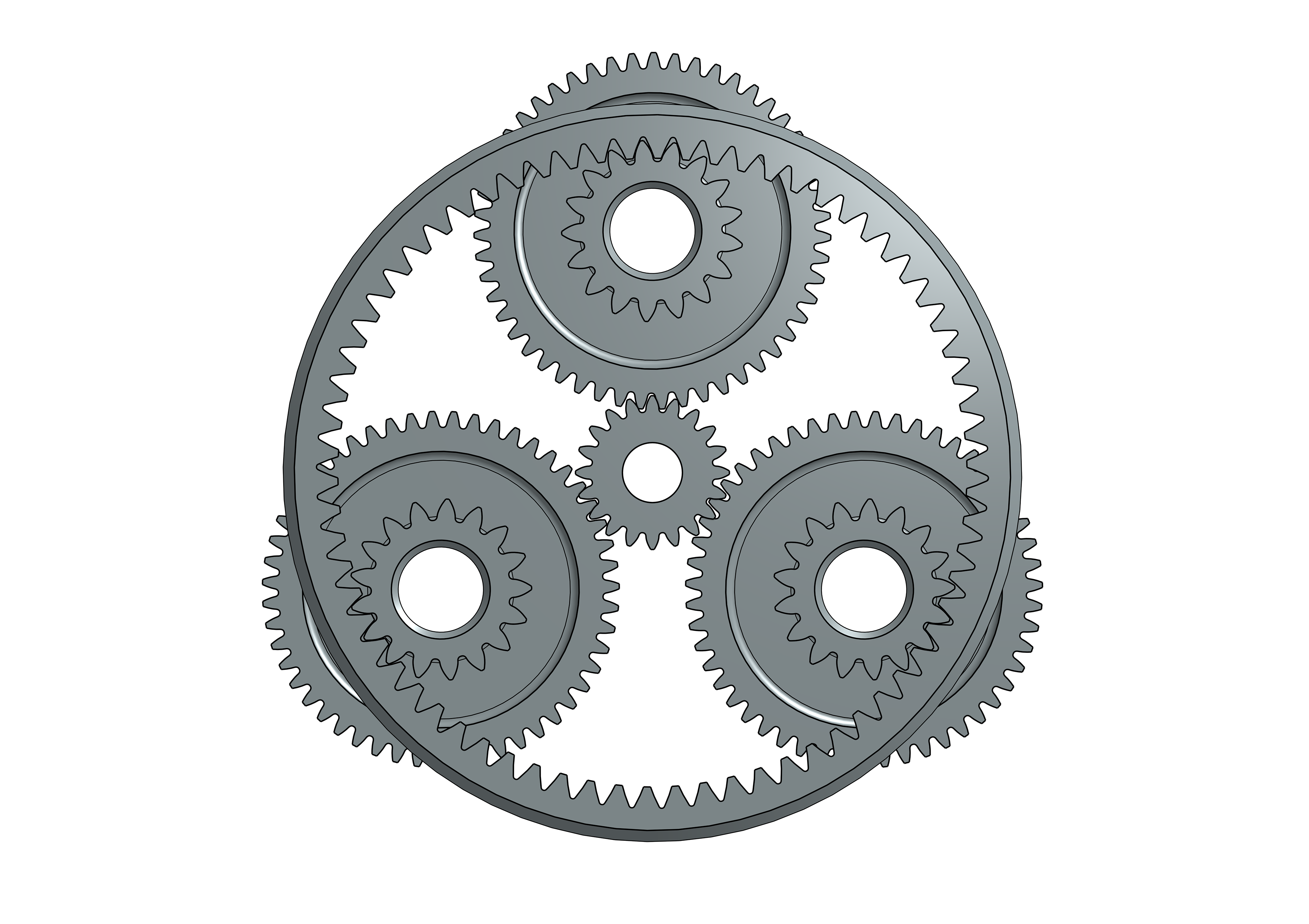
The final gearset, made (almost) completely in house. (if you include a shop in Vermont as in house)
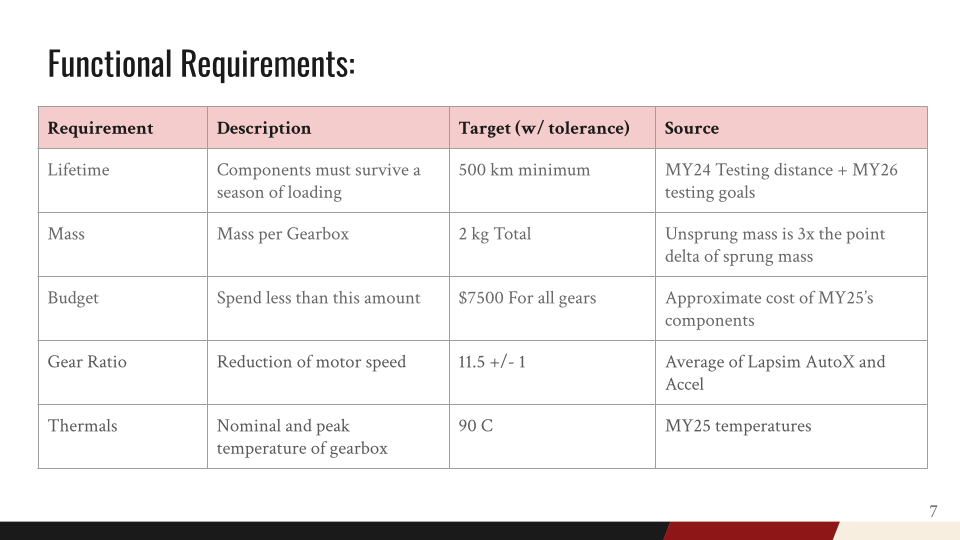
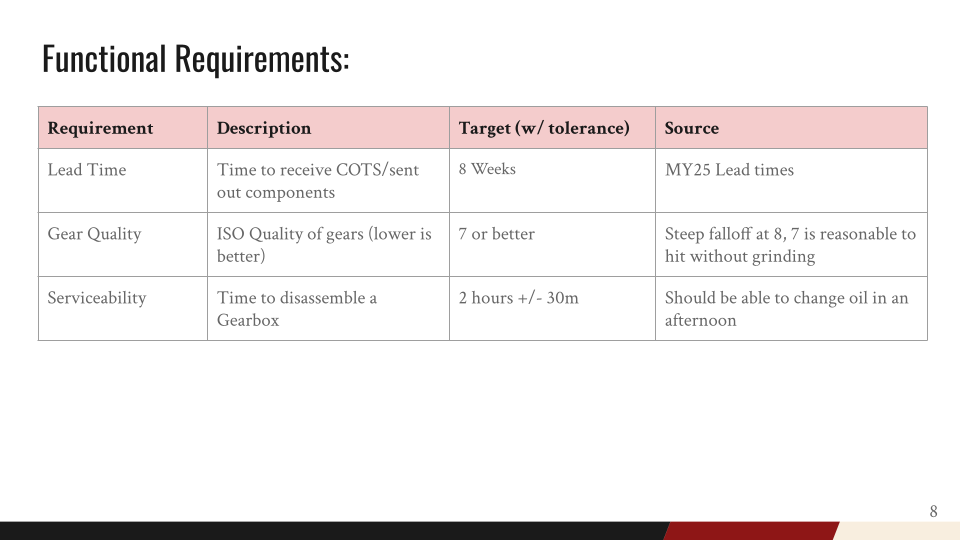
As with all engineering projects, I began with defining the functional requirements, which are the requirements we must meet that can be defined numerically. The main changes from the previous year were a lower mass requirement, as well as a lower thermal requirement as we did not observe the MY25 gearset reaching the predicted temperature of 100C.
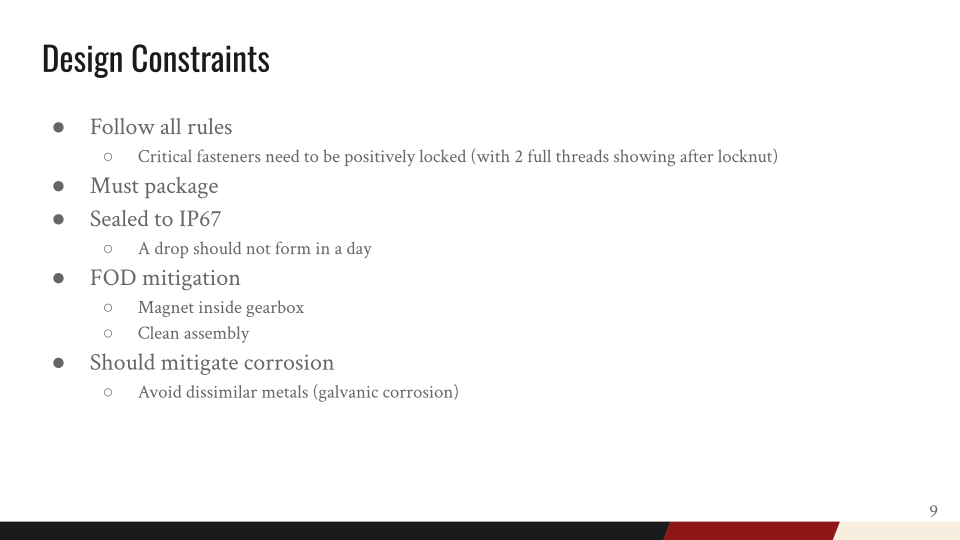
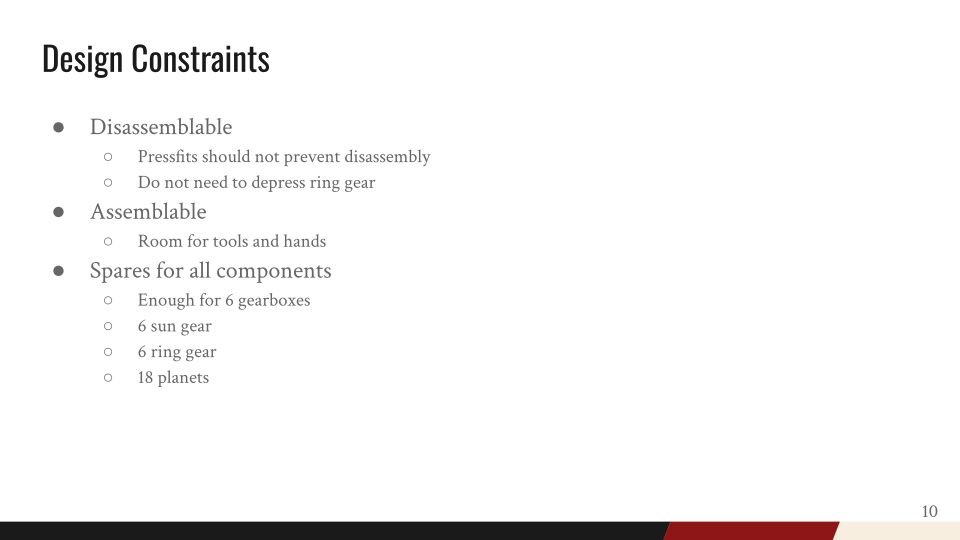
I then defined our design constraints, which are the requirements that can be answered with yes or no. These were relatively unchanged from MY25.
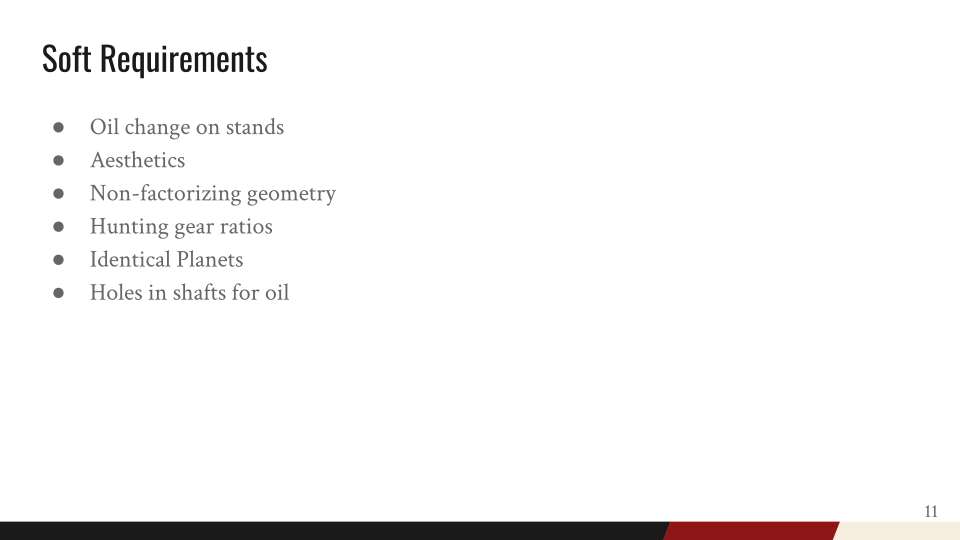
Finally, I defined our soft requirements. These are the "nice to haves" of the system. The main ones I was focused on were the "non factorizing" and the "hunting" requirement, as well as the "Identical planet" requirement to simplify assembly down the line.
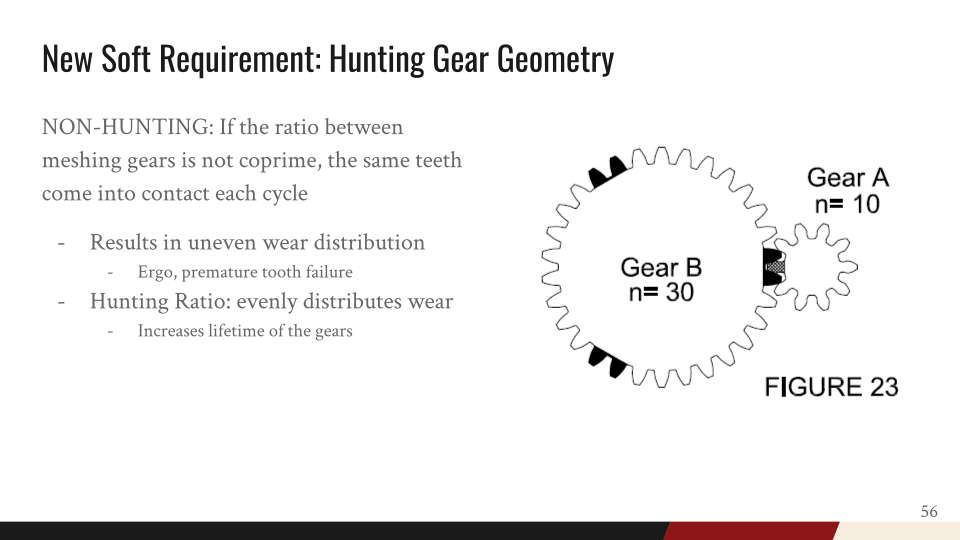
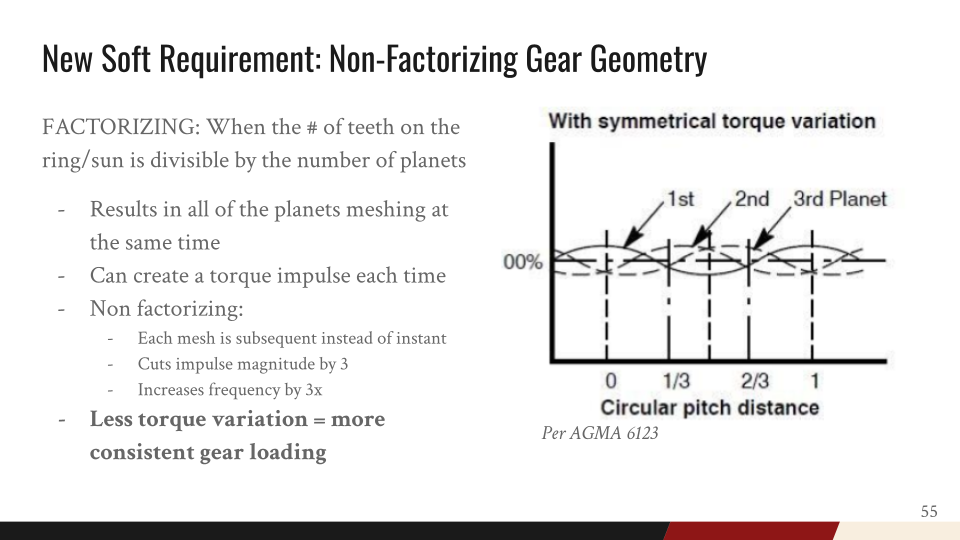
Some slides from the appendix of my PDR. These detail why I wanted to pursue the hunting and non factorizing requirements for the gearset.
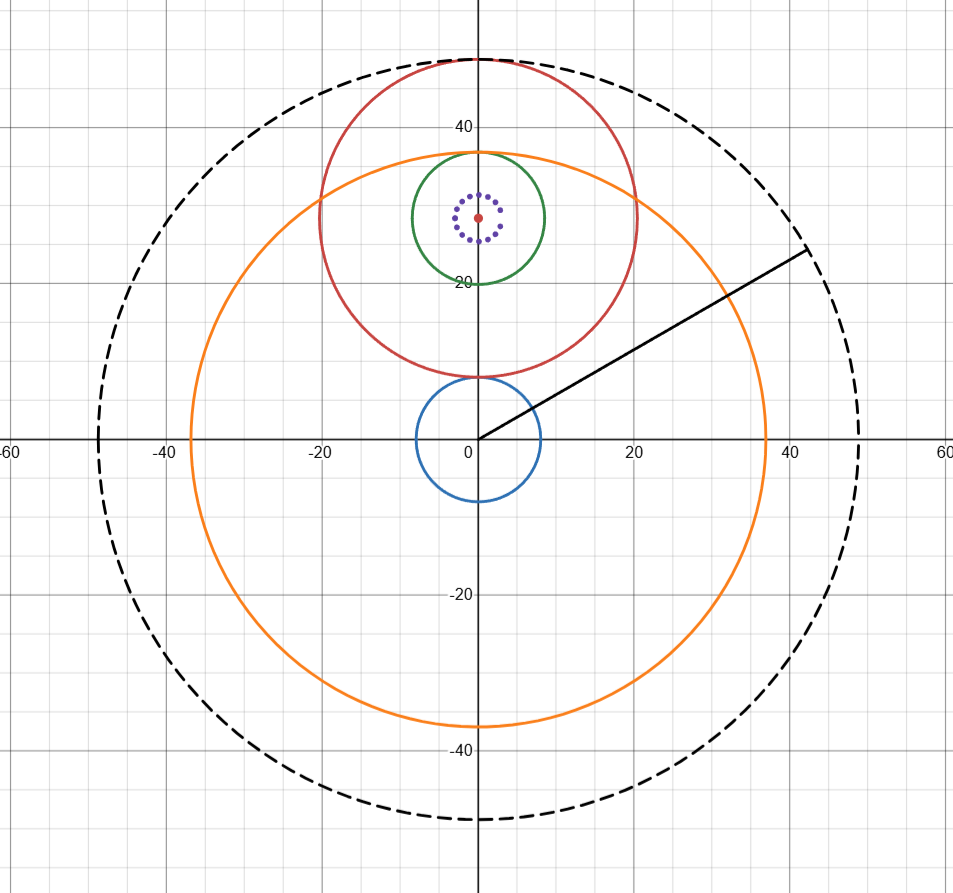
From there, I moved onto figuring out the geometry. I modified a Desmos program I created to sweep through potential tooth combinations to find one that worked for our requirements. Similarly to MY25, I went with different tooth profiles on the first and second stage of the stepped planetary, allowing each planet to have a whole number 3:1 ratio. This means that each planet can be identical, simplifying manufacturing and assembly considerably.
As we had already decided to switch to Brembo brake calipers in MY26, I had to find a way to make the gearbox smaller. Shrinking the sun gear was the most efficient way to do that, so I reduced the size to 20 teeth, down from 22 in MY25, which made the gearbox almost two centimeters smaller in diameter. This gearbox is a 54:20 ratio for the first stage at 32 DP, and a 70:17 ratio on the second stage at 24 DP, for an overall ratio of 10.5:1, hitting all of the soft requirements.
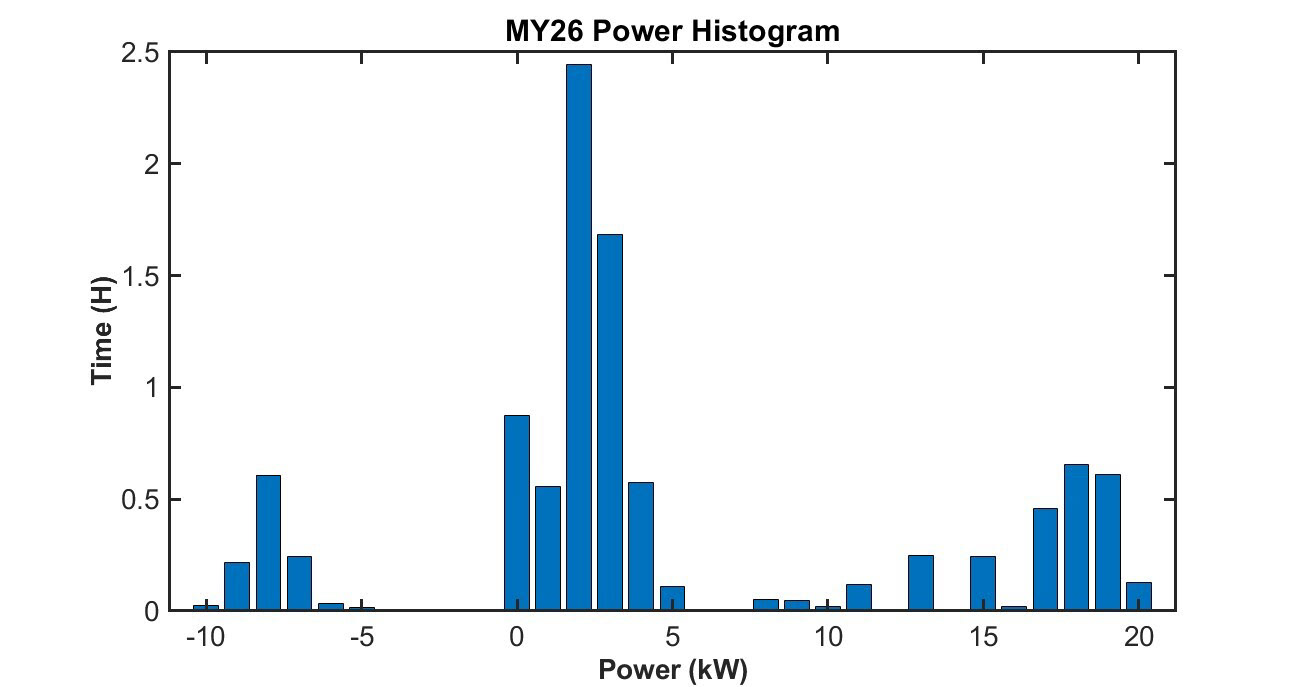
The next step was sizing the gear themselves, which started with the lapsim. In MY25, we made a conservative loading assumption that the car would spend its whole life in autocross loading, which is an event where the driver tries to complete one lap as fast as possible. Additionally, we had removed all zero power cycles from the histogram, resulting in large and heavy gears. For MY26, I relaxed this assumption, and made a less conservative assumption of 40% autocross, 60% endurance loading, an event where the car drives 20 laps with other cars on the track, resulting in lower power and a lot of lift and coast events. Additionally, we accounted for regenerative braking.
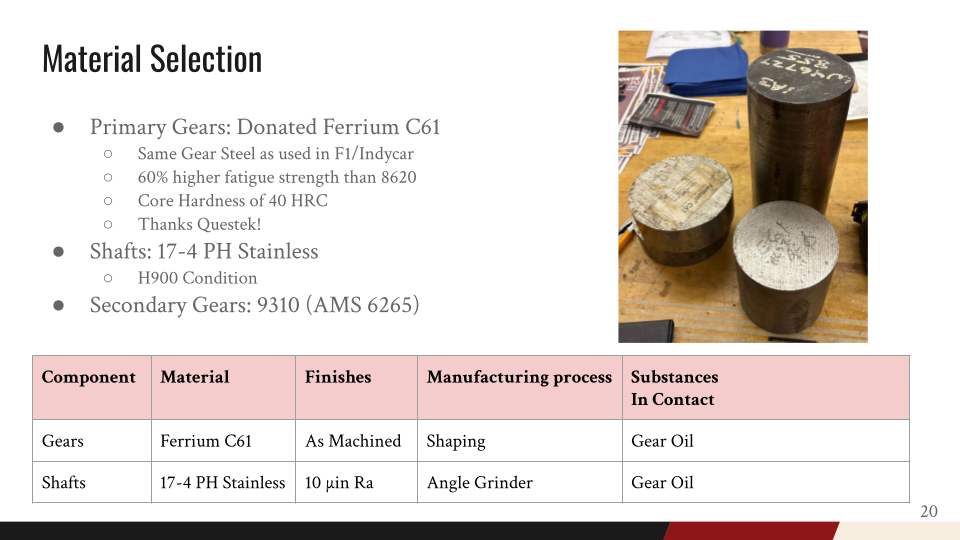
For our gear material, we graciously received billets of a steel known as Ferrium C61 from a professor at MIT, Professor Greg Olson, who developed the steel. Ferrium C61 was one of the first computationally designed steels, designed specifically for motorsport gearboxes such as the ones used in Formula 1 and Indycar. However, C61 is designed to be vacuum carburized. This process hardens the surface of the gear teeth to allow for high strength in contact stress, while keeping the core relatively softer to help with fatigue strength using high heat to allow carbon to diffuse into the steel. However, this process also can cause warpage of the gears, reducing their quality. As a result, carburized gears require a post grind, which we did not have the capabilities for. As a result, we prefer to nitride the gears, which has a similar effect that occurs at lower temperatures, resulting in much less warpage. While this is typically not as strong as carburization due to a lower case depth, these gears are so small that the case depth for both would be around the same, resulting in similar strength. However, we still applied a small knockdown factor.
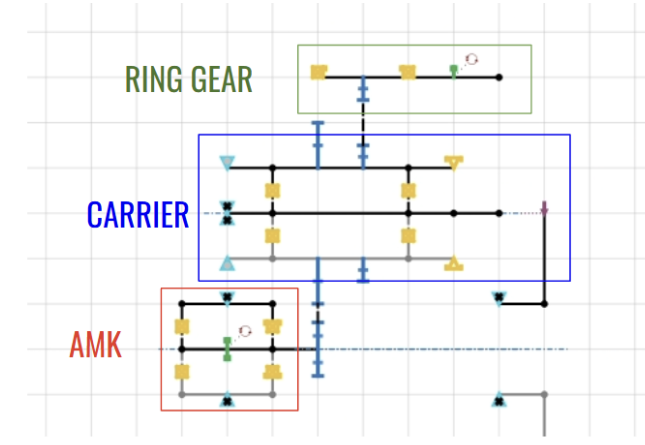
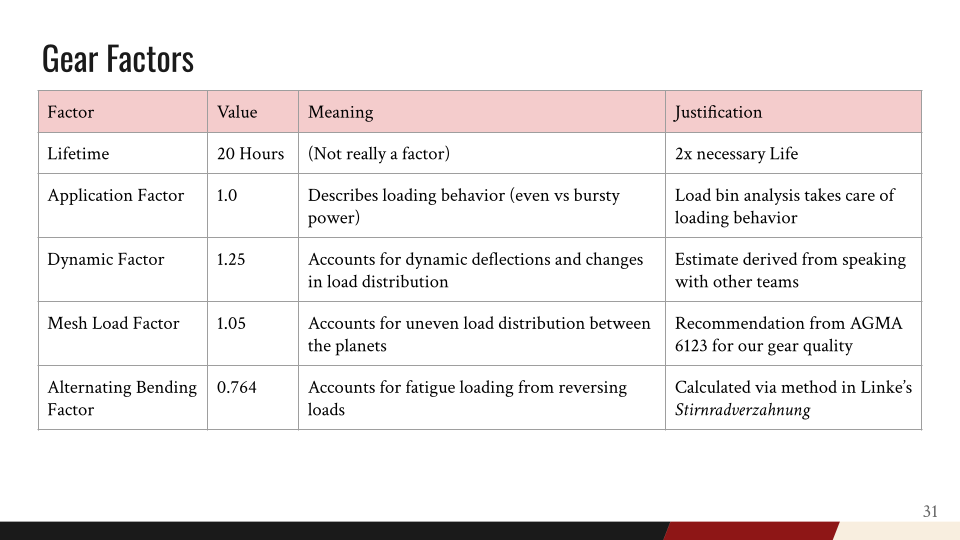
Sizing was done in Kisssoft AG using ISO 6336. We aimed for a root FoS of 1.5 and a Flank FoS of 1.25.
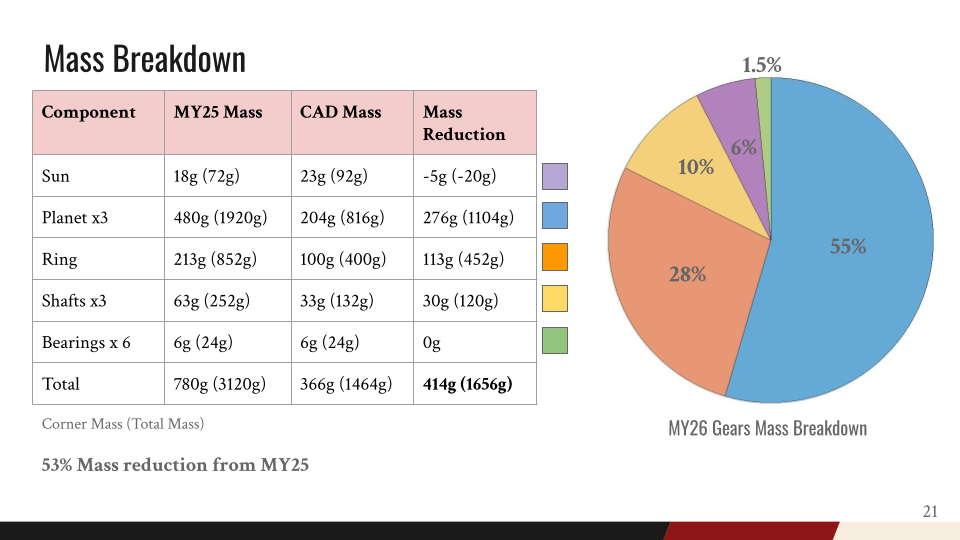
As a result, I saved a lot of mass over the MY25 gearset.
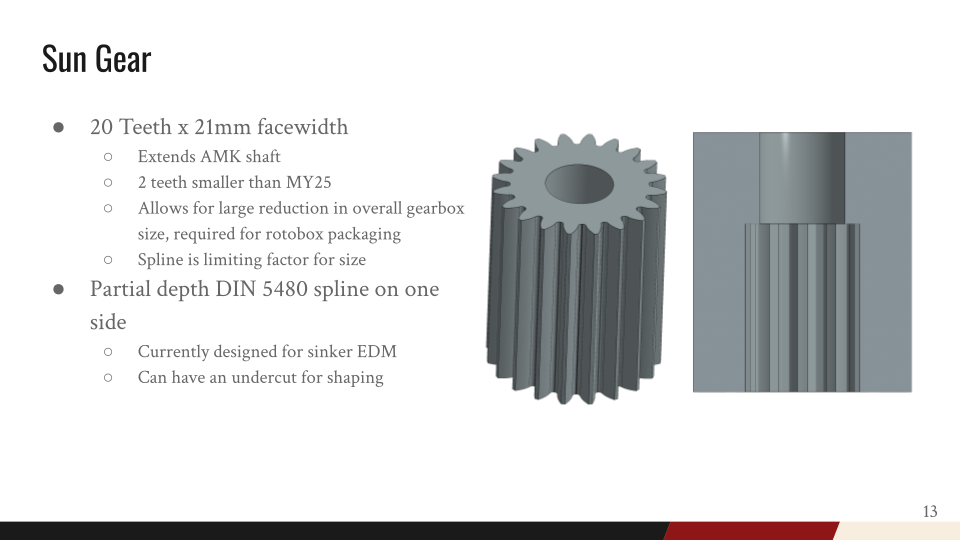
Due to the smaller sun, we couldn't have the shaft run inside of the sun gear, as the rim below the teeth would become too thin. As a result, we instead pursued a sinker EDM spline, which allowed us to offset the mesh at the cost of increased manufacturing cost.
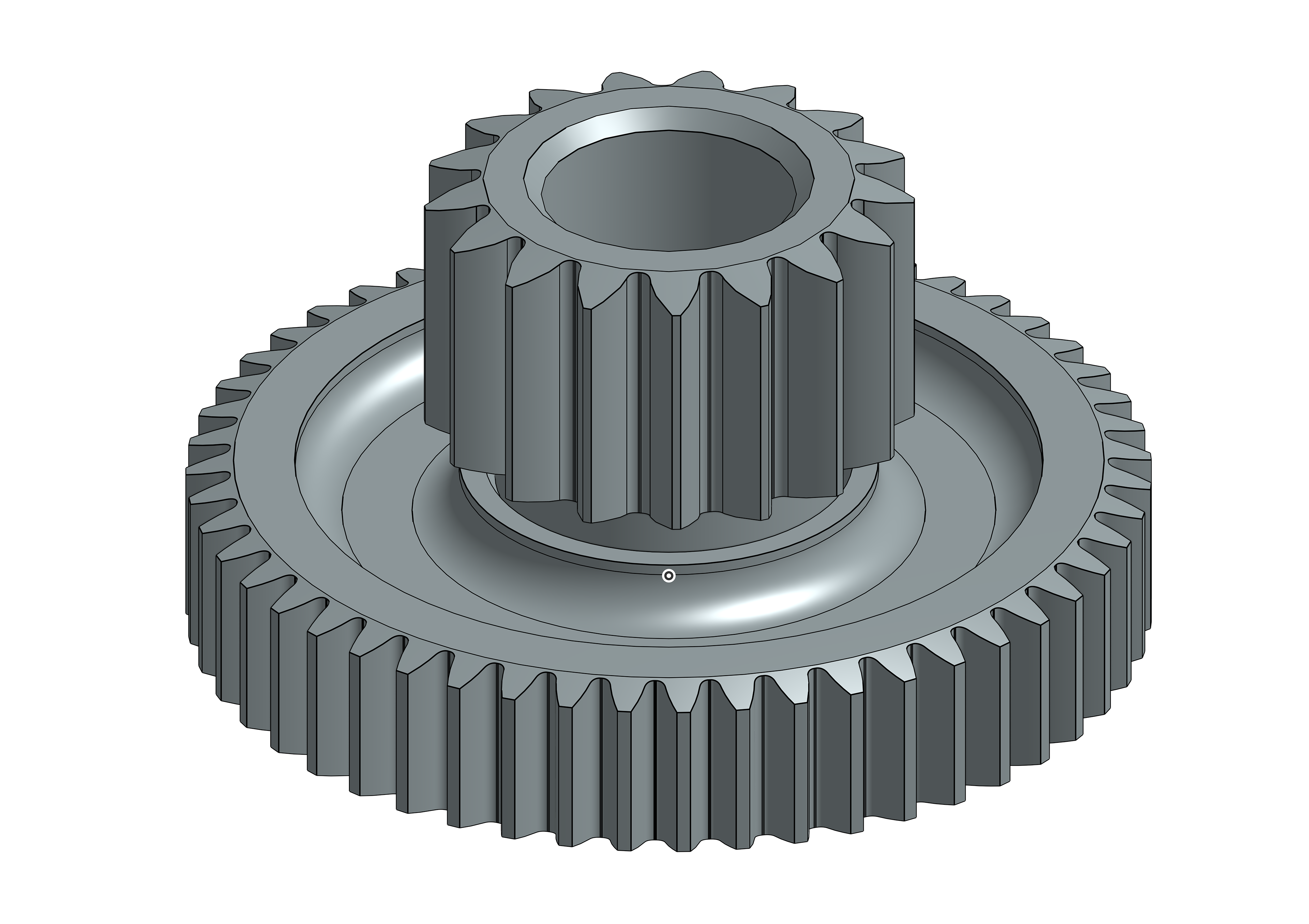
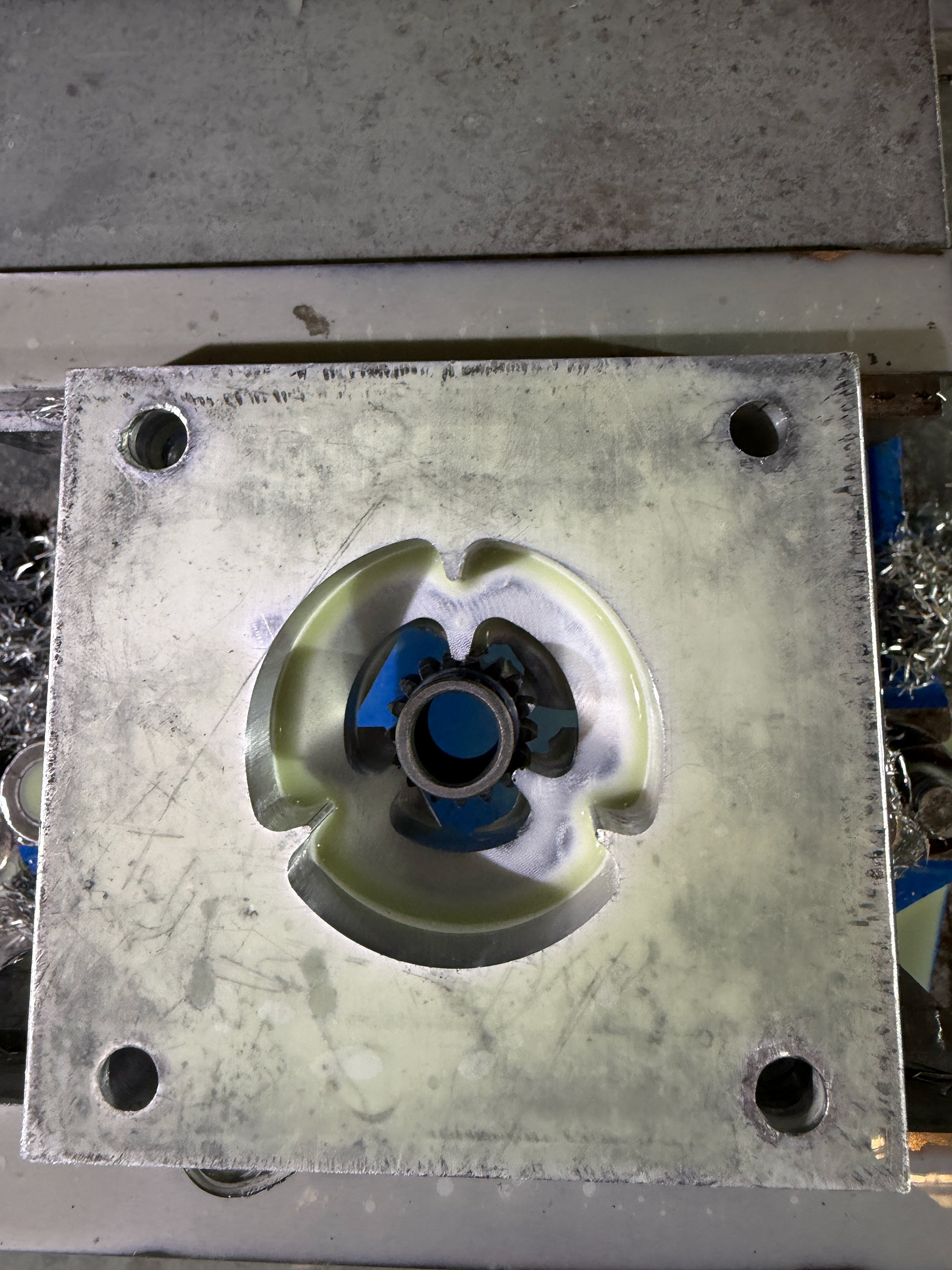
The planet gear changed a bit between the CDR and our manufacturing sprint. While we originally planned on shaping the gears together, manufacturing the blanks proved to be too complex, so we instead chose to manufacture them separately and press-fit them together with a clocking jig. To ensure the gears would not slip, we created a press-fit between the gears helped by Loctite 648, which had a very healthy factor of safety compared to the torque through the gear. This simplified our manufacturing considerably.
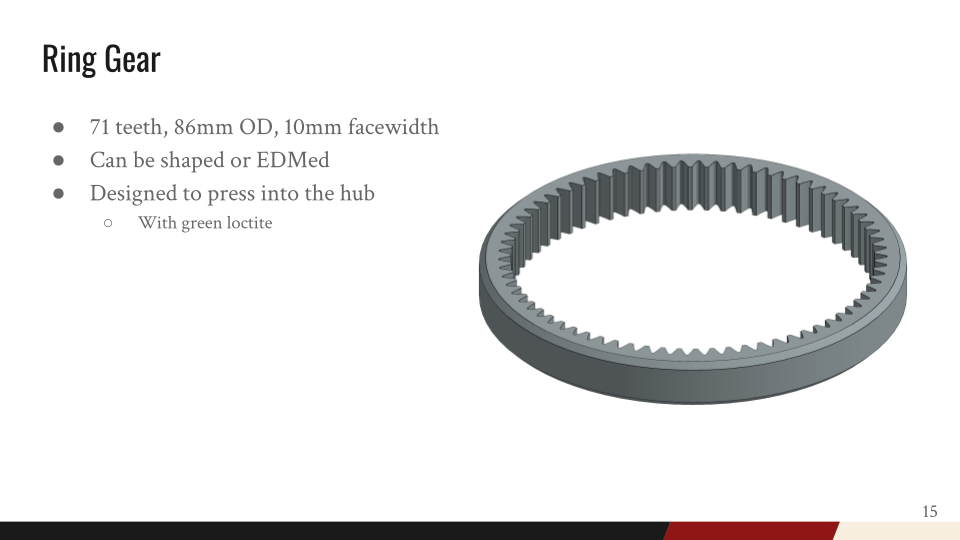
The ring gear tries to be as simple as possible. It thermally press-fits into the wheel hub also using Loctite 648, which worked like a charm.
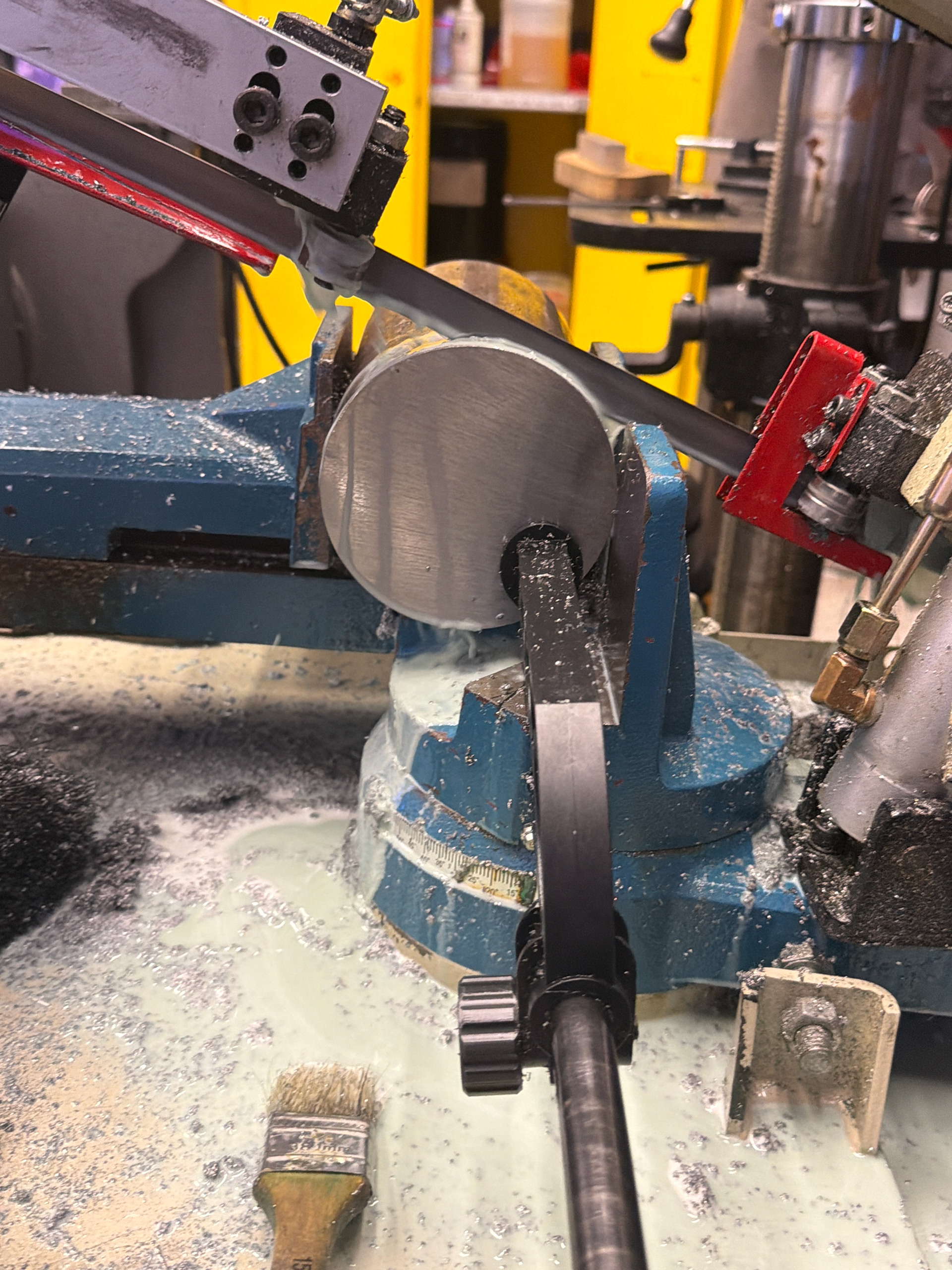
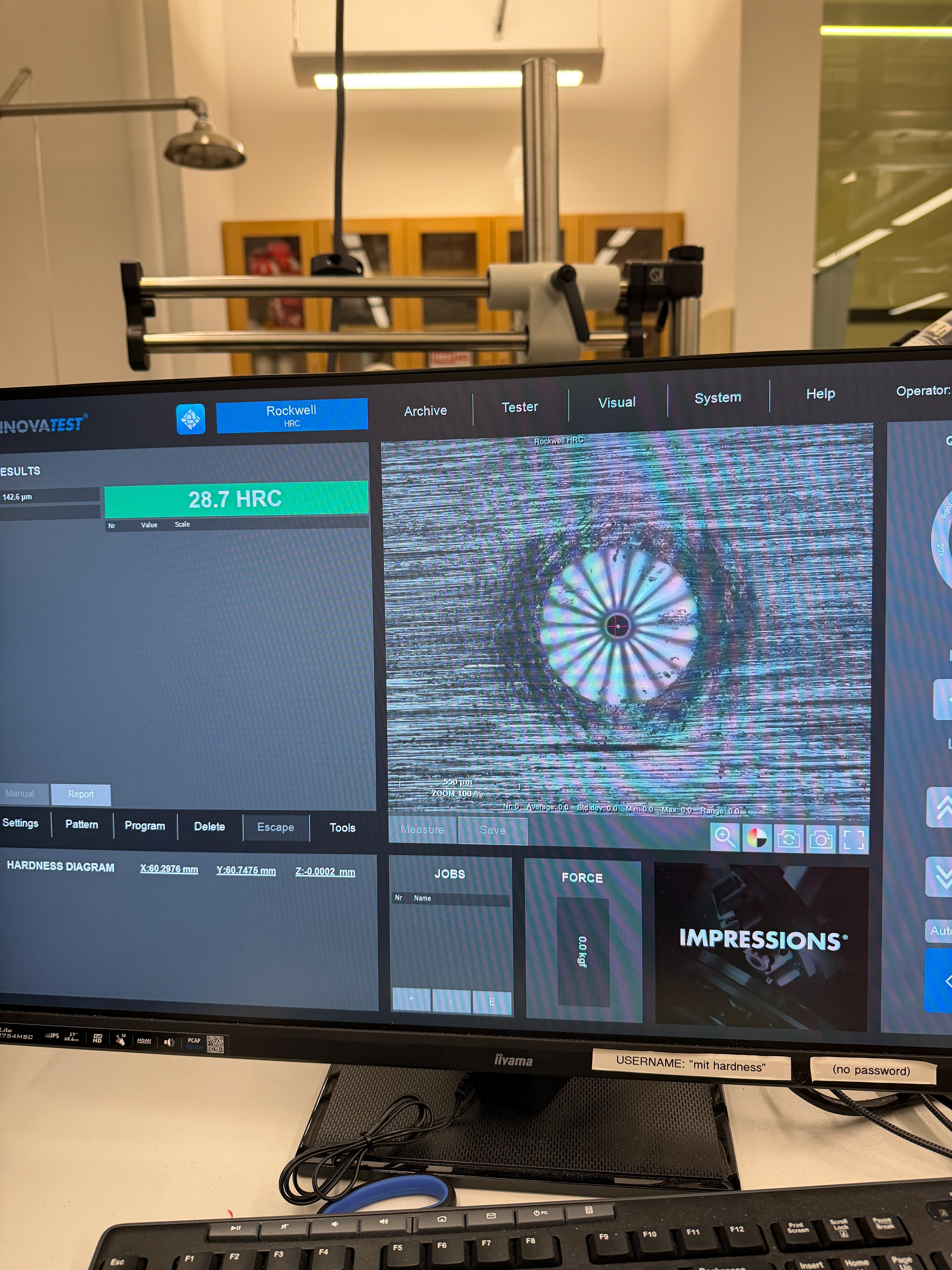
Manufacturing began with making slices of the stock we were given. While round bar would have made manufacturing much easier (only a lathe operation), we were given large billets, which required some more intensive manufacturing. We then hardness tested the steel to ensure we had a good core hardness. For our gears, we needed a minimum core hardness of 25 HRC, which we luckily hit. Had the steel been annealed, we would have needed to normalize the steel.
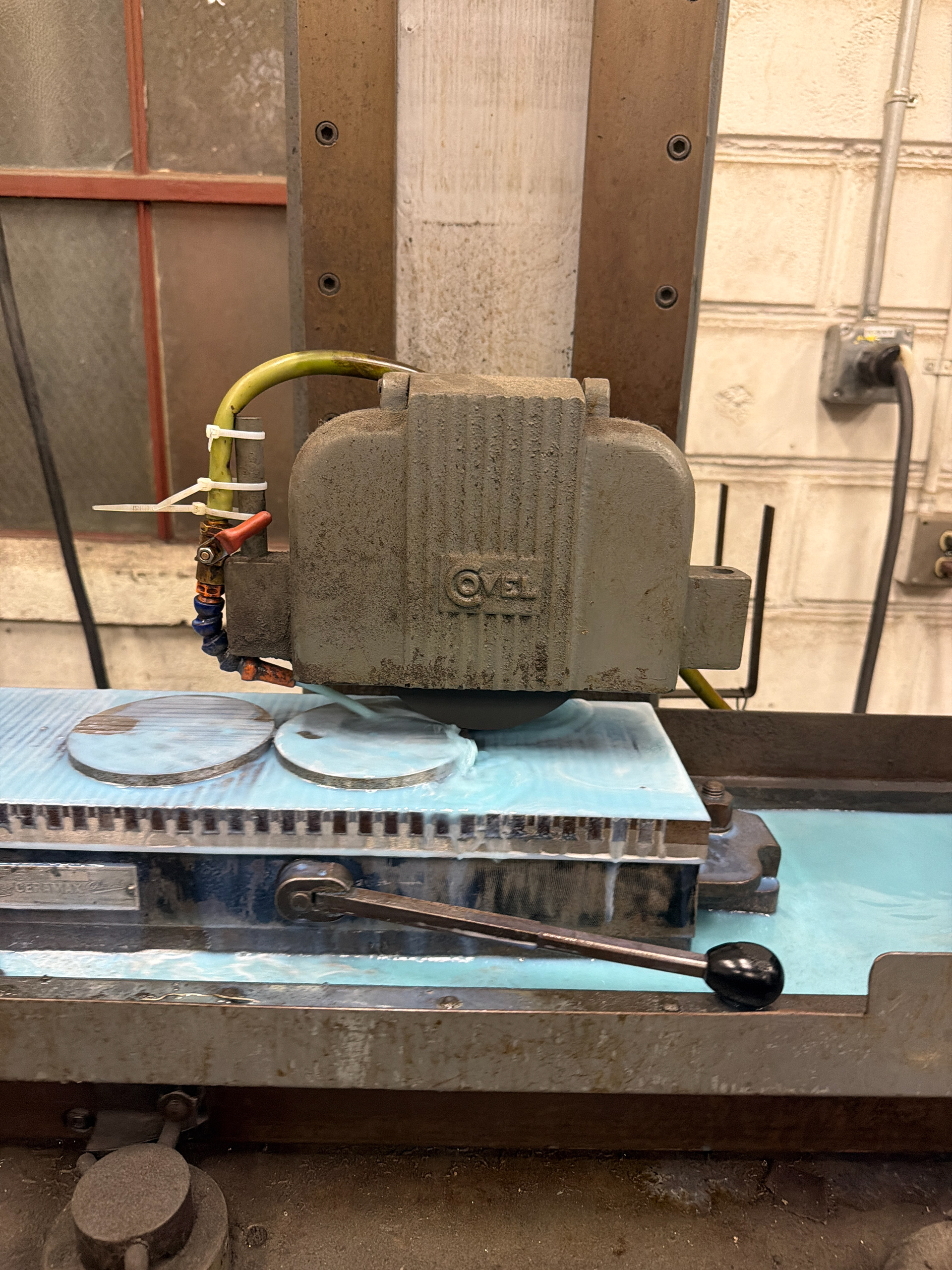
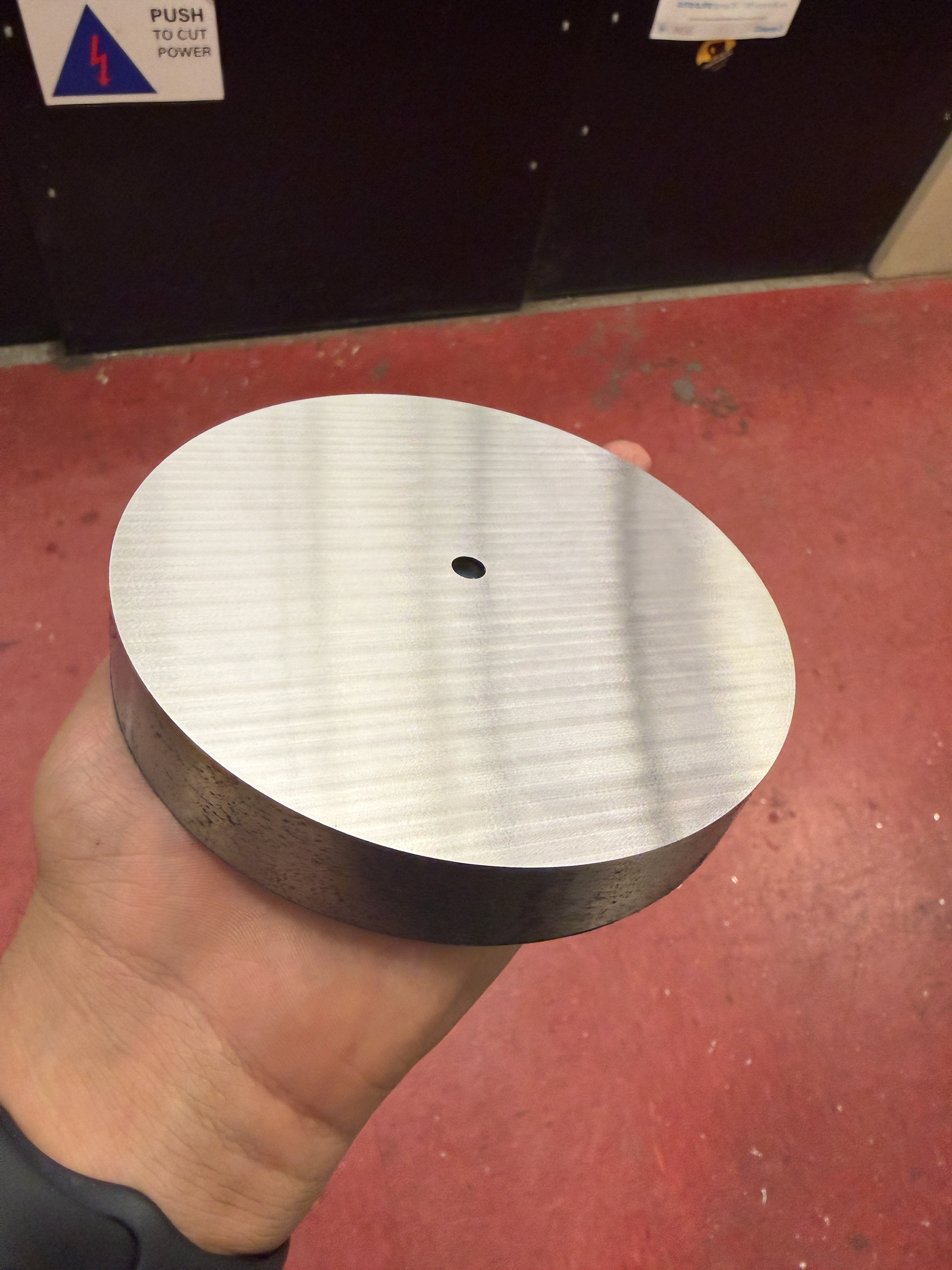
I then drilled holes as pilots for later steps, and surface ground the pucks to thickness. This step required over 100 hours of manual labor, as the surface grinder was a manual machine from the 60s.
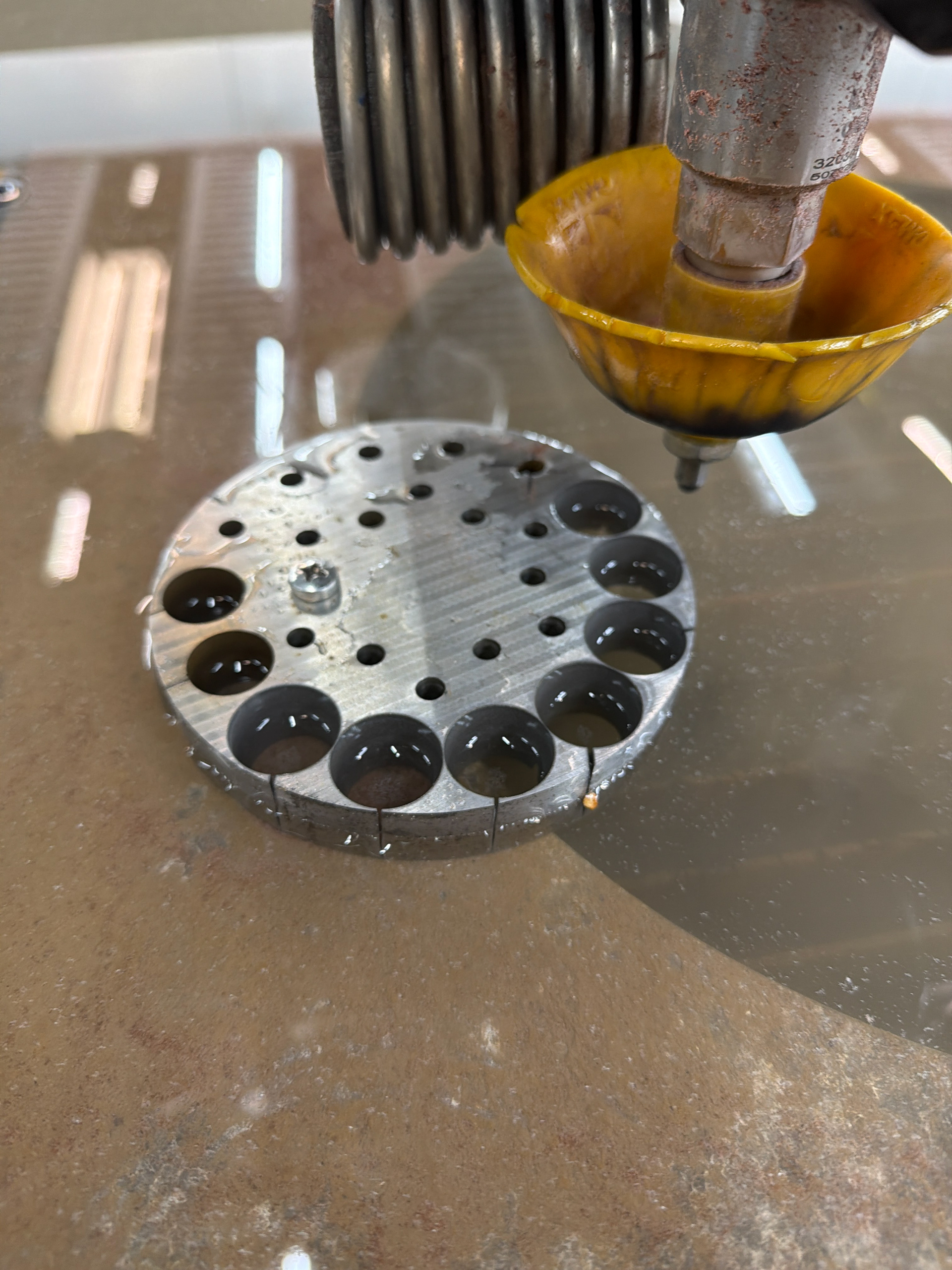
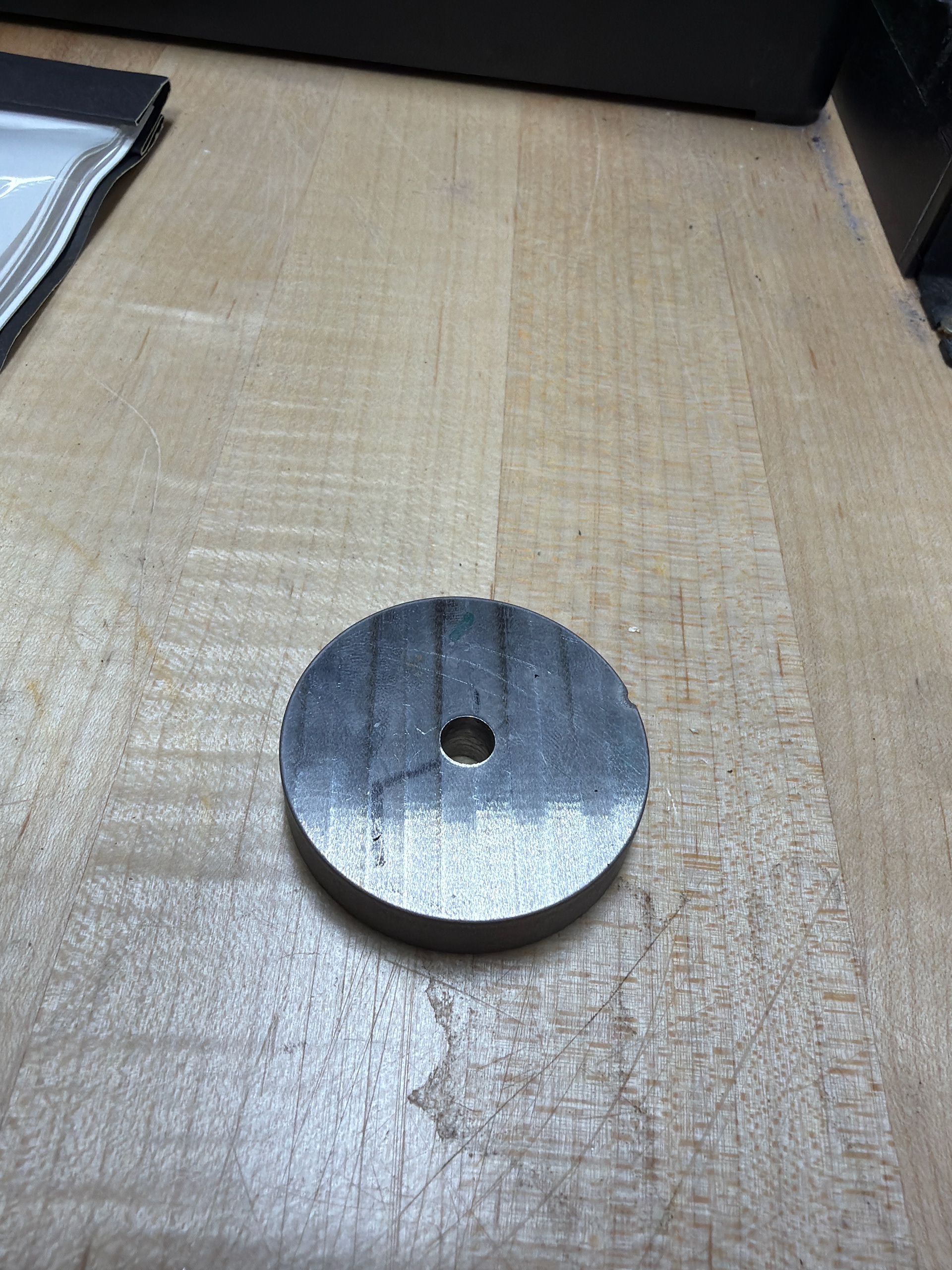
I then located the holes and waterjet blanks from the pucks.
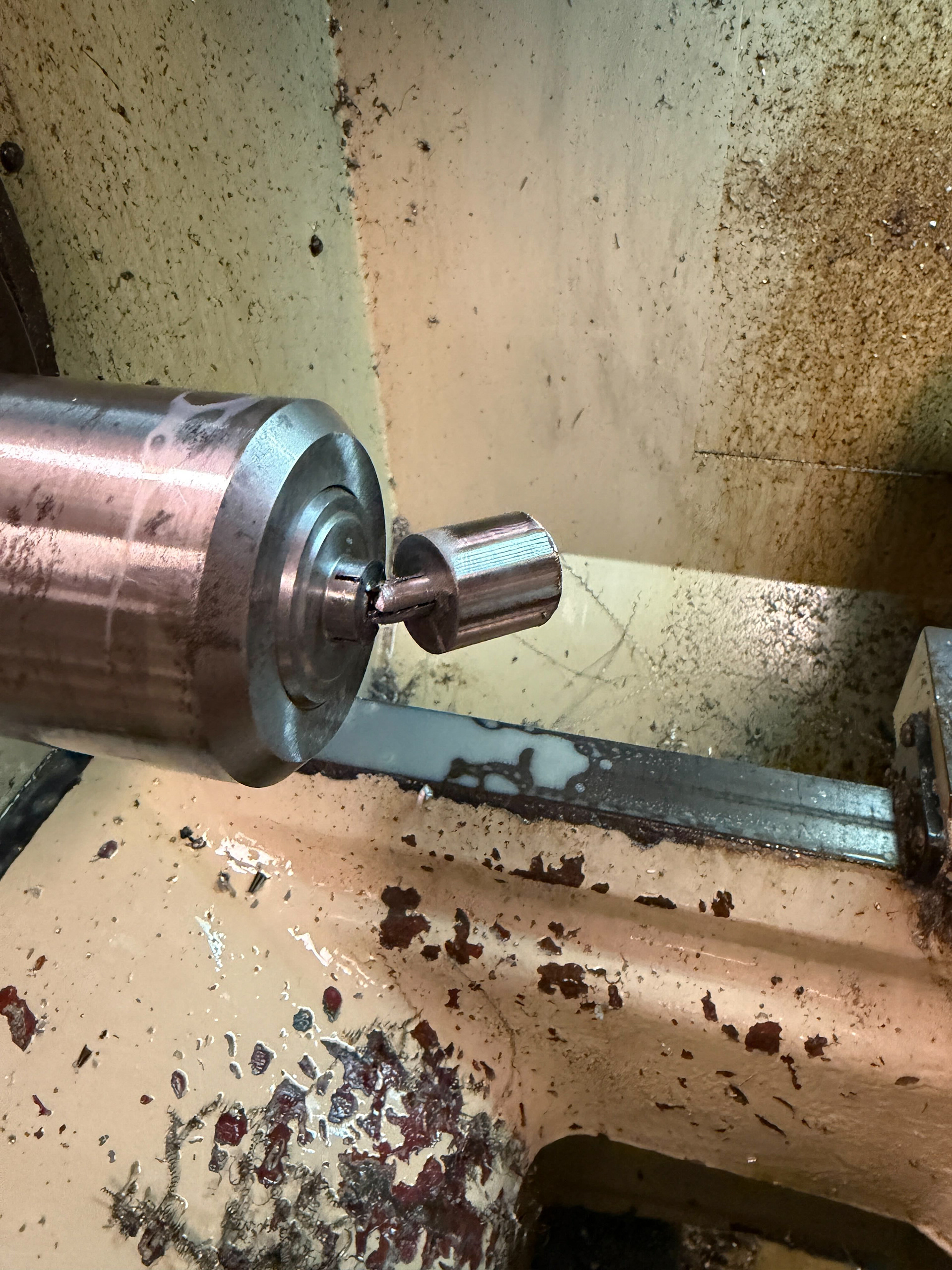
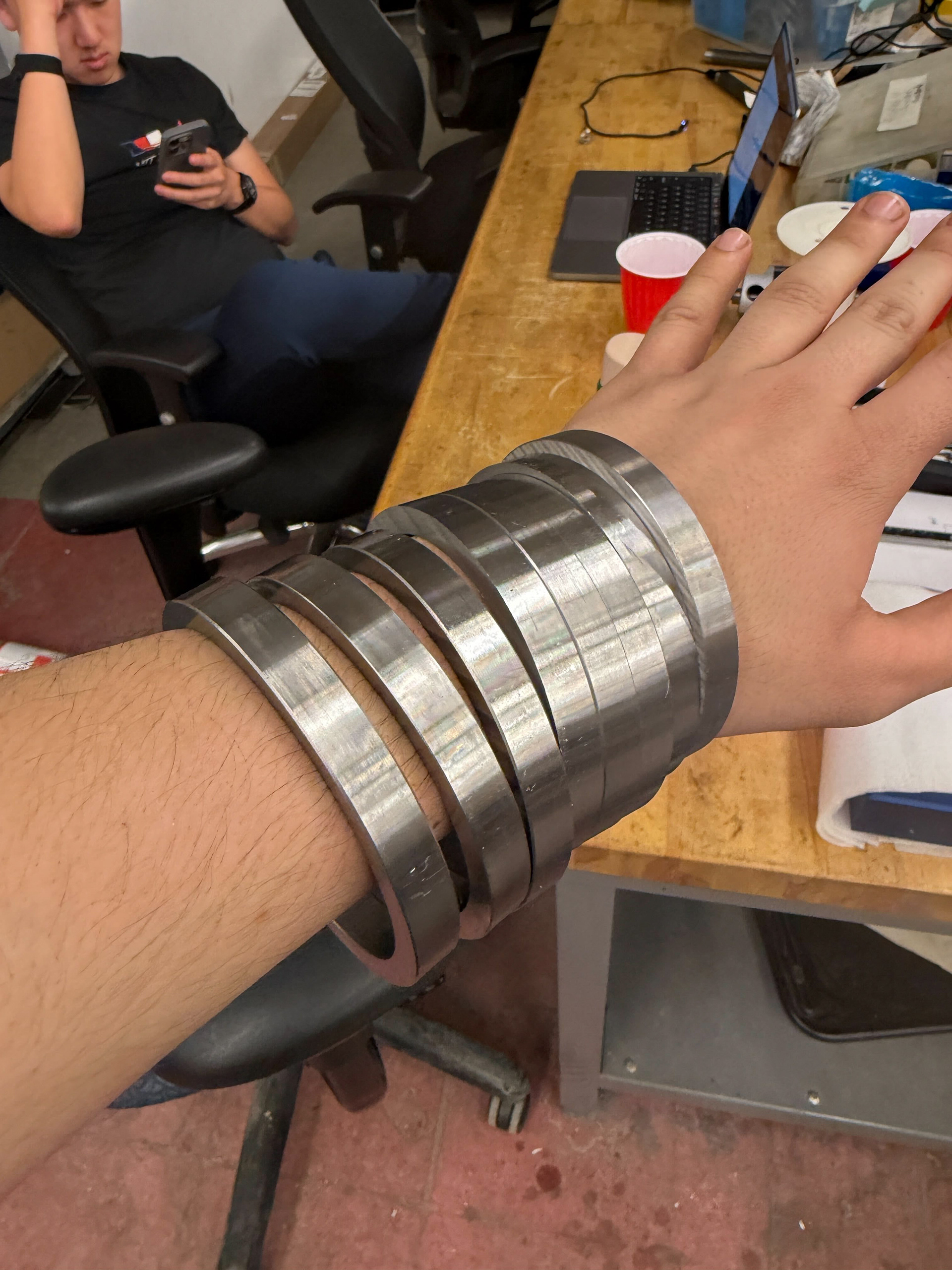
From there, hours of tedious work was conducted on the lathe to get the blanks in spec. The blanks needed to be incredible concentric, with bores within a thou each. I spent dozens of hours turning down each blank.
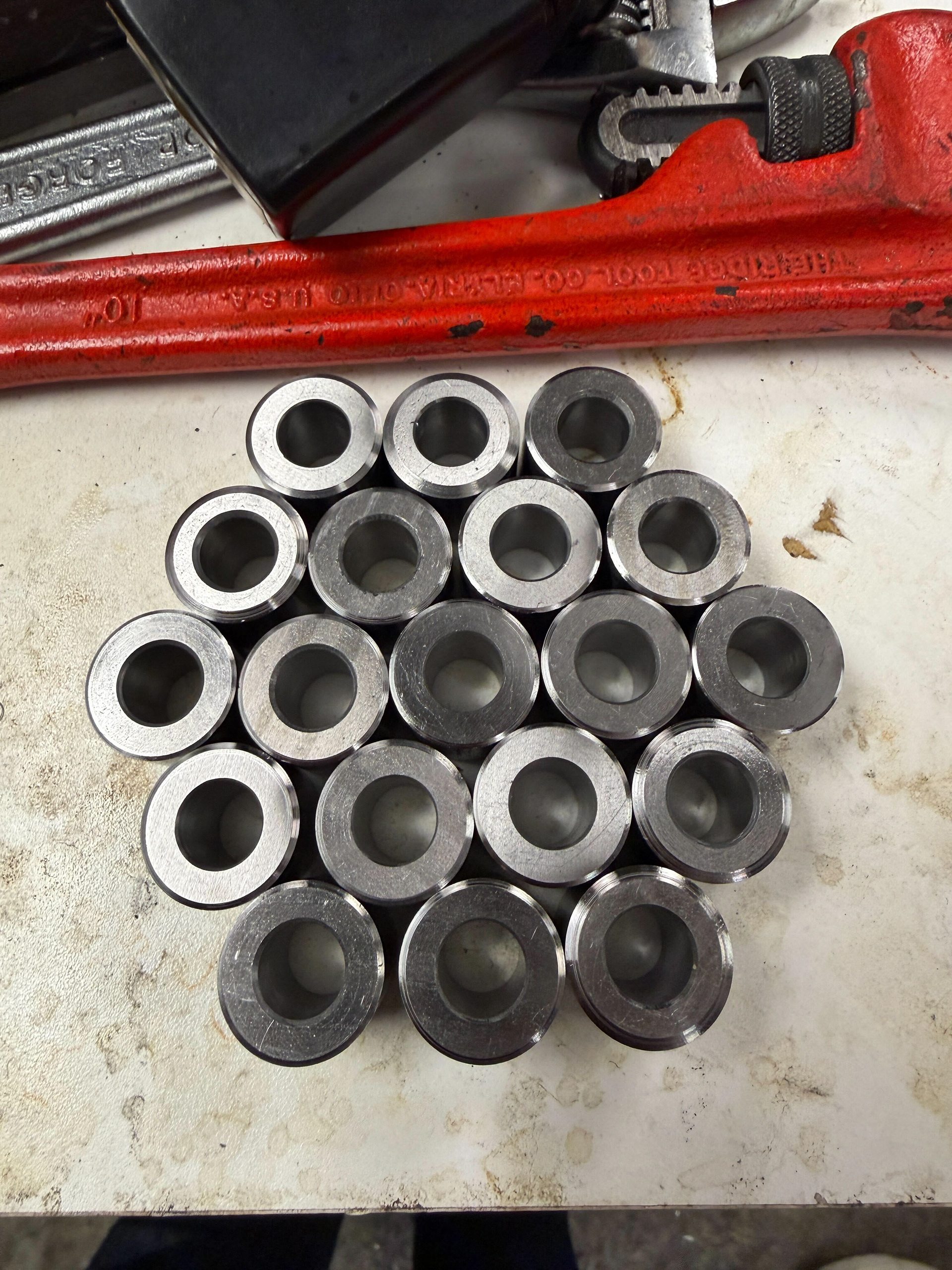
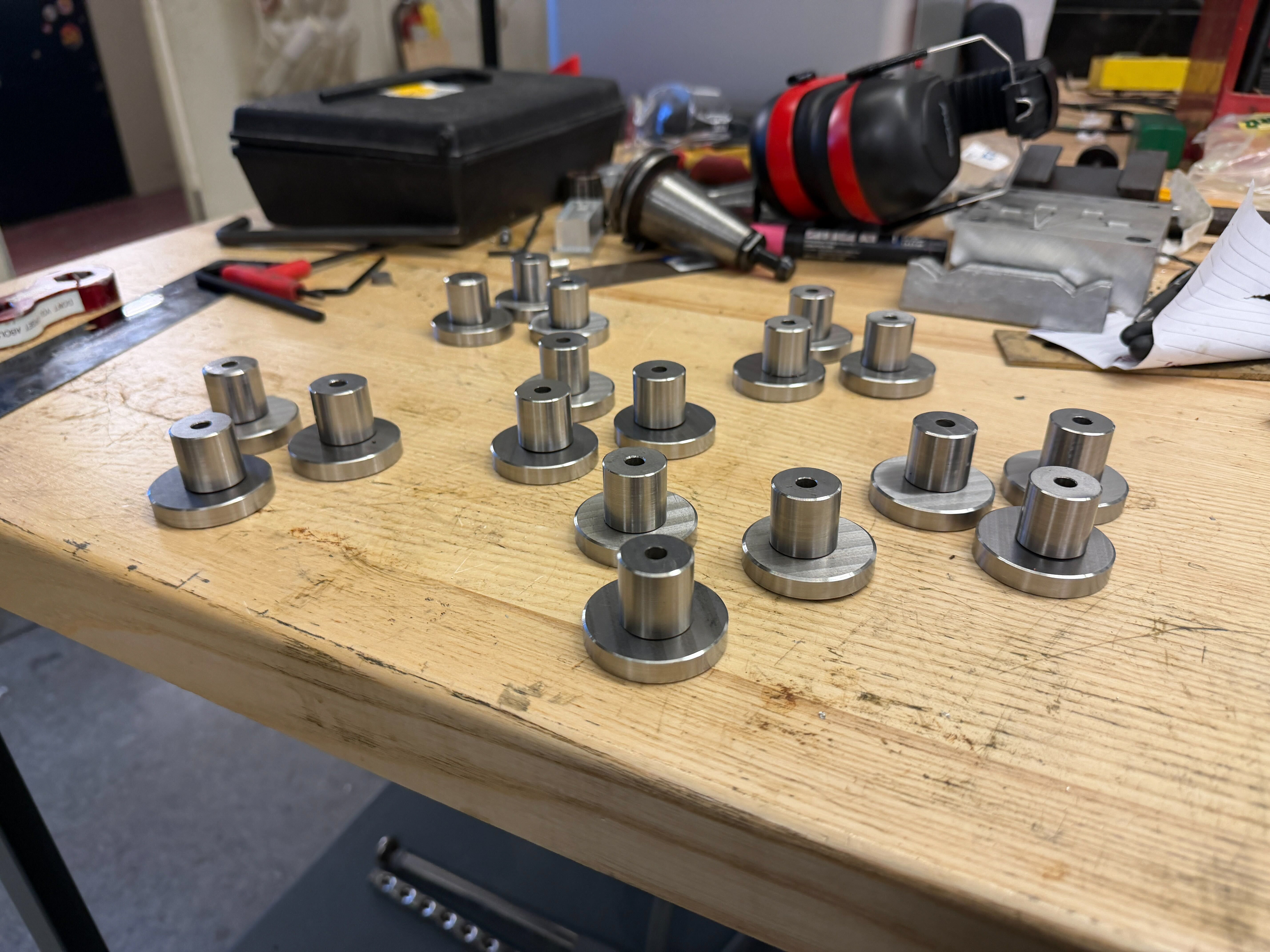
Completed blanks!
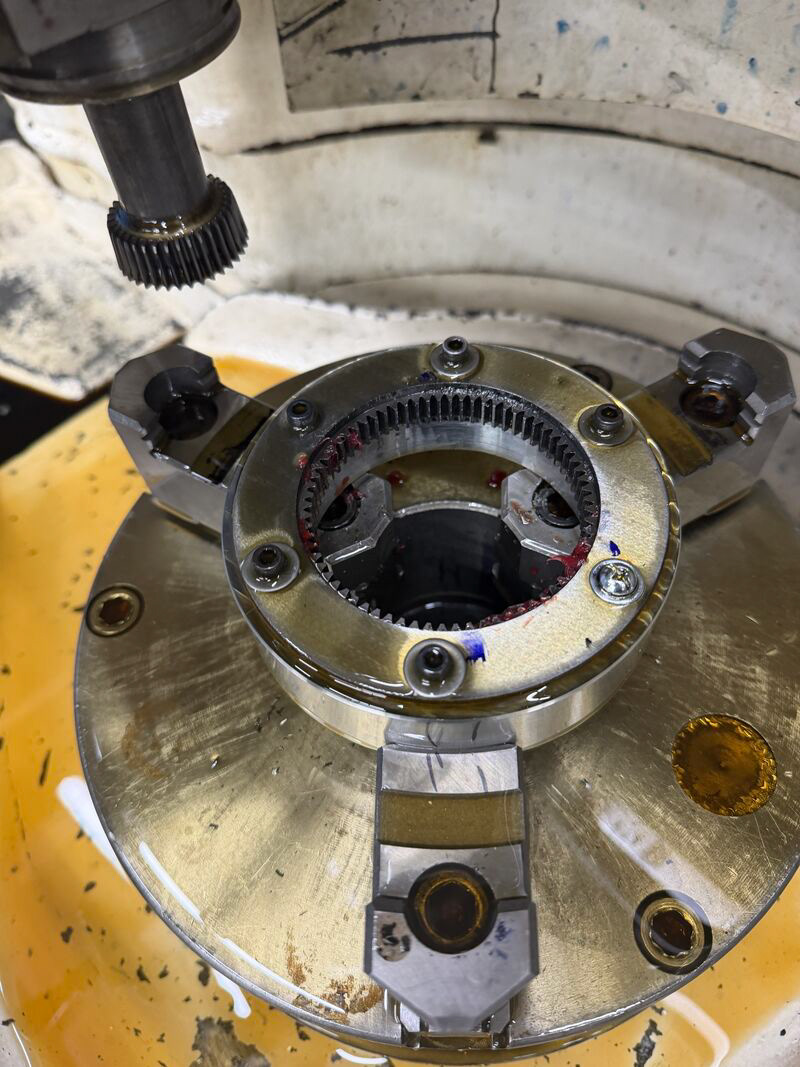
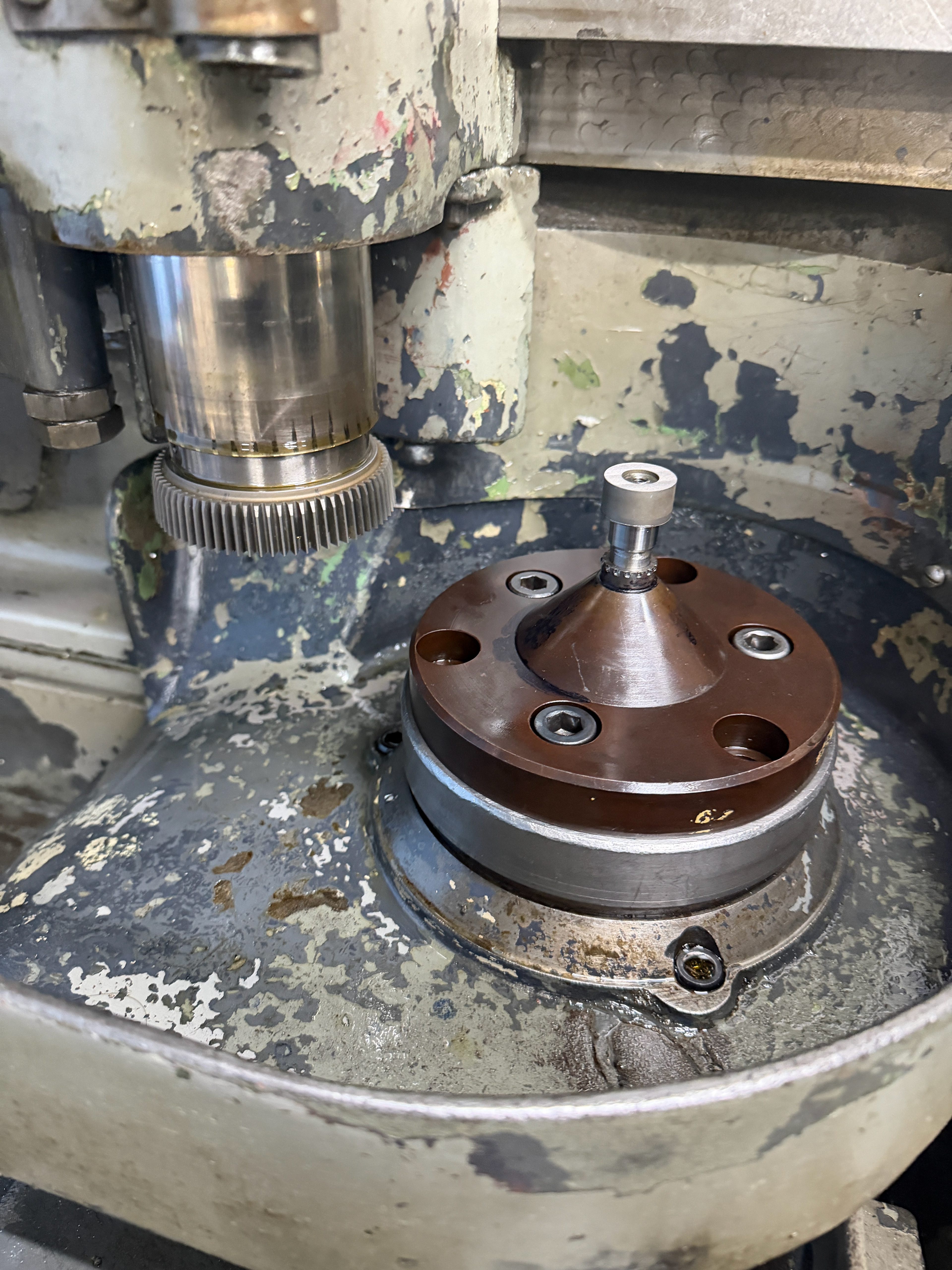
From there, we drove up to Vermont. Don Shattuck of Gear Works Inc. in Springfield Vermont had graciously allowed us to stay at the shop to machine the gears using his restored fellows type 6 and 7 gear shapers.
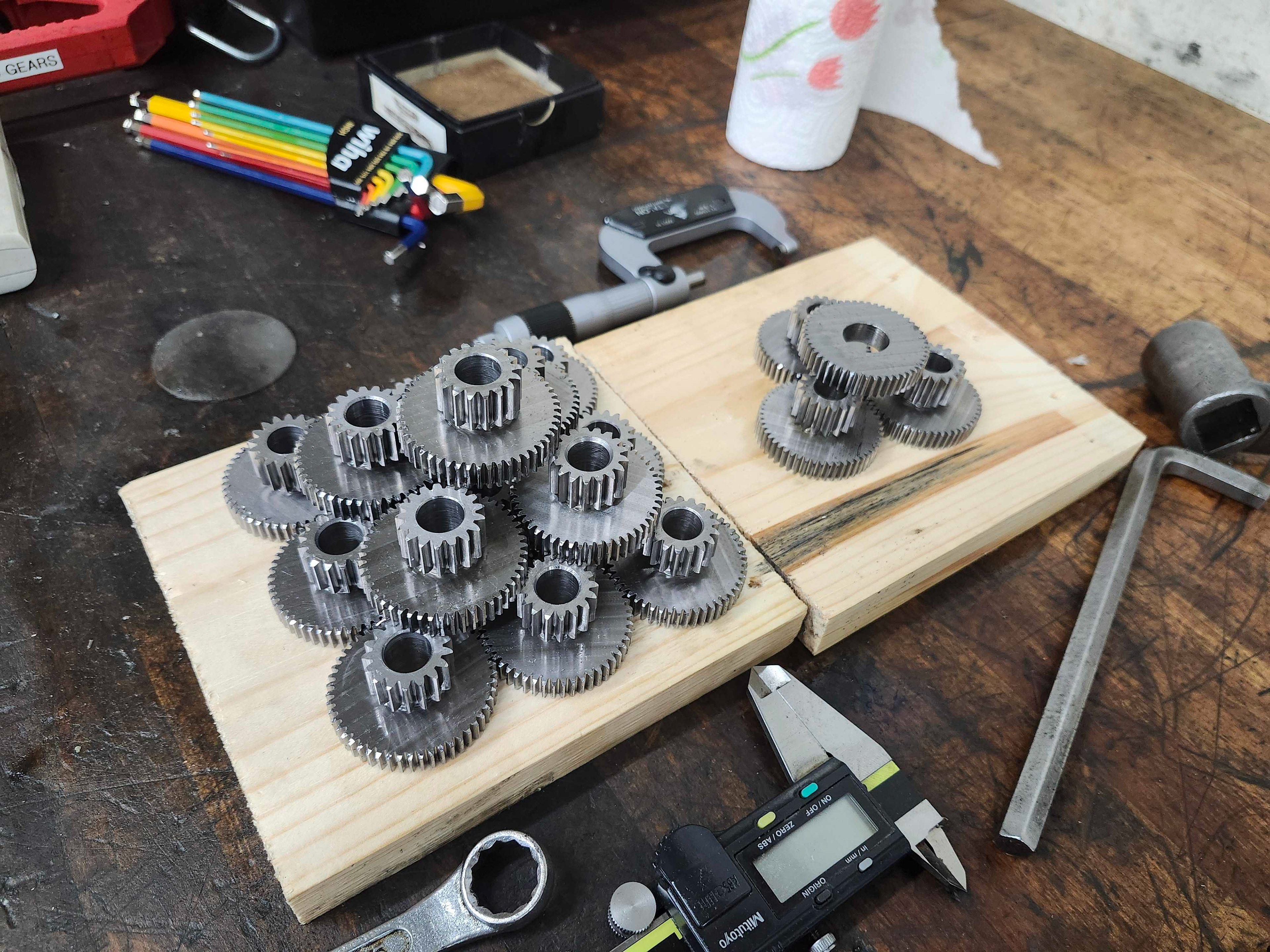
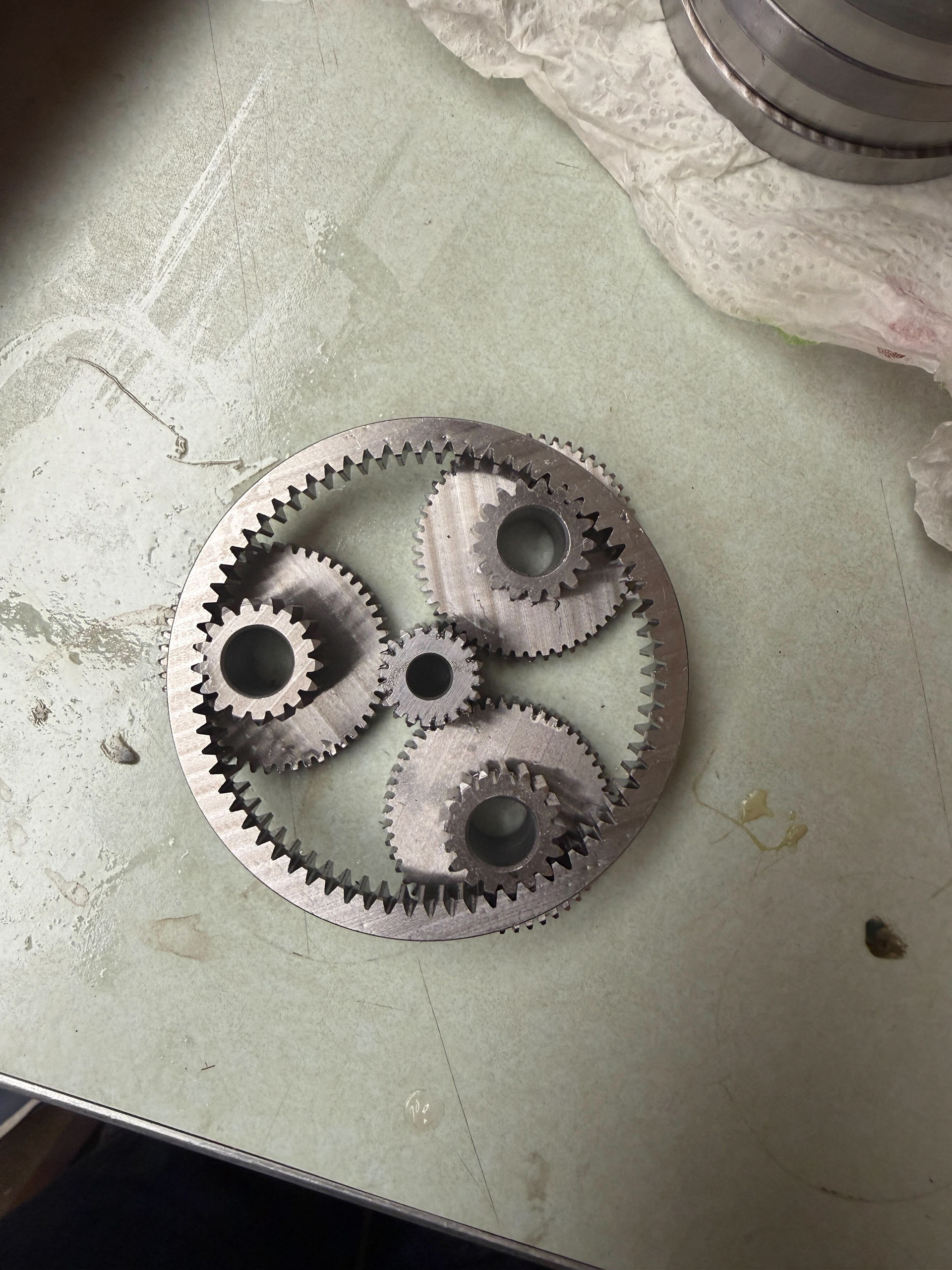
The first planets, and our first finished set. The gears were incredibly precise, and I only measured around 0.0002" of variation across pins from the machines.
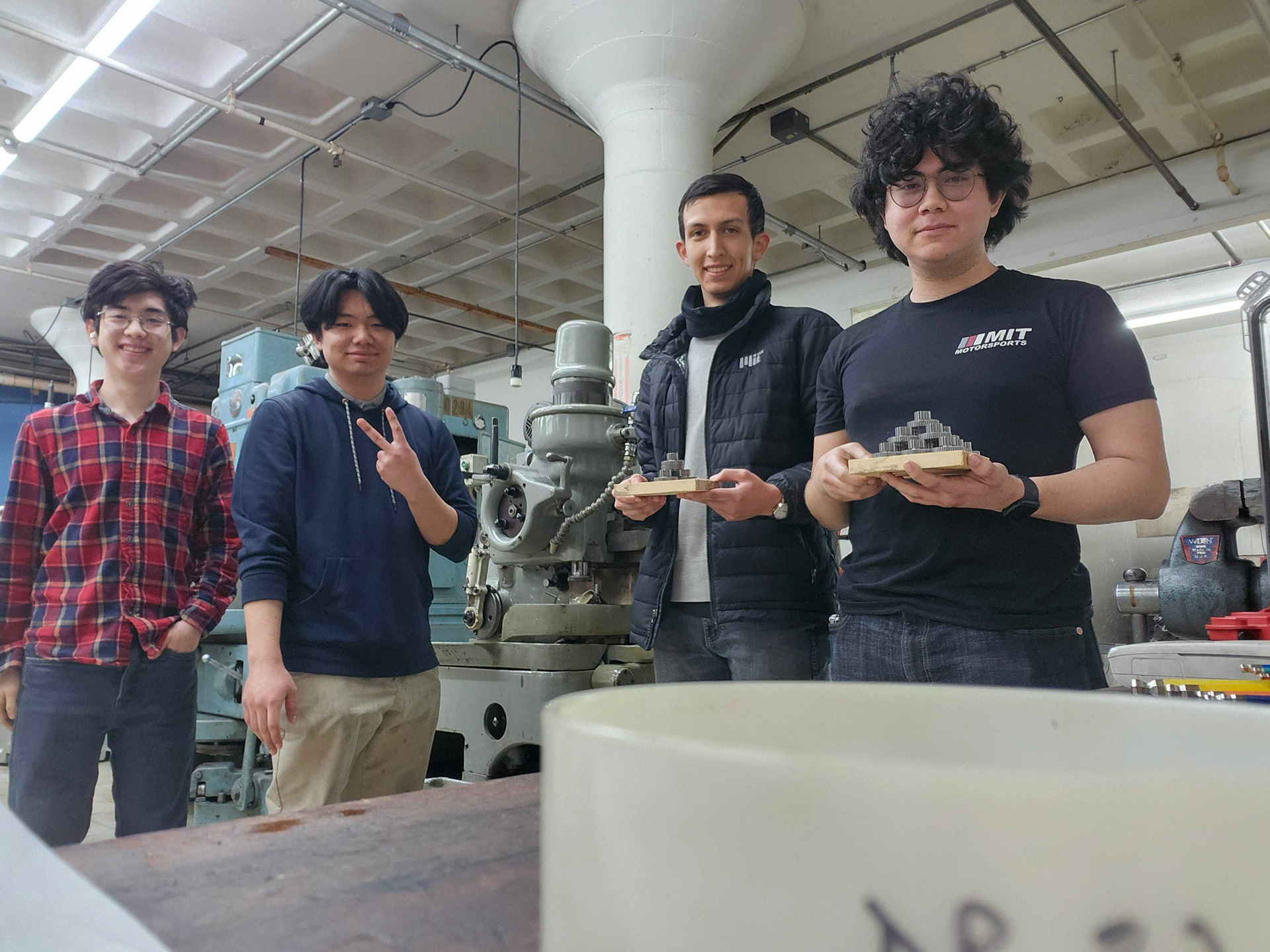
The team that made it all possible with shaping. We were able to run two machines in parallel, resulting in finishing all the gears in just a few weekends. Thank you to Evan Lim '29, Michael Vuong '28, and Rafael Tejeda '28, who is replacing me on the team for the MY27 year.
(ignore my terrible hair, we had been sleeping in the shop for two days)
(ignore my terrible hair, we had been sleeping in the shop for two days)
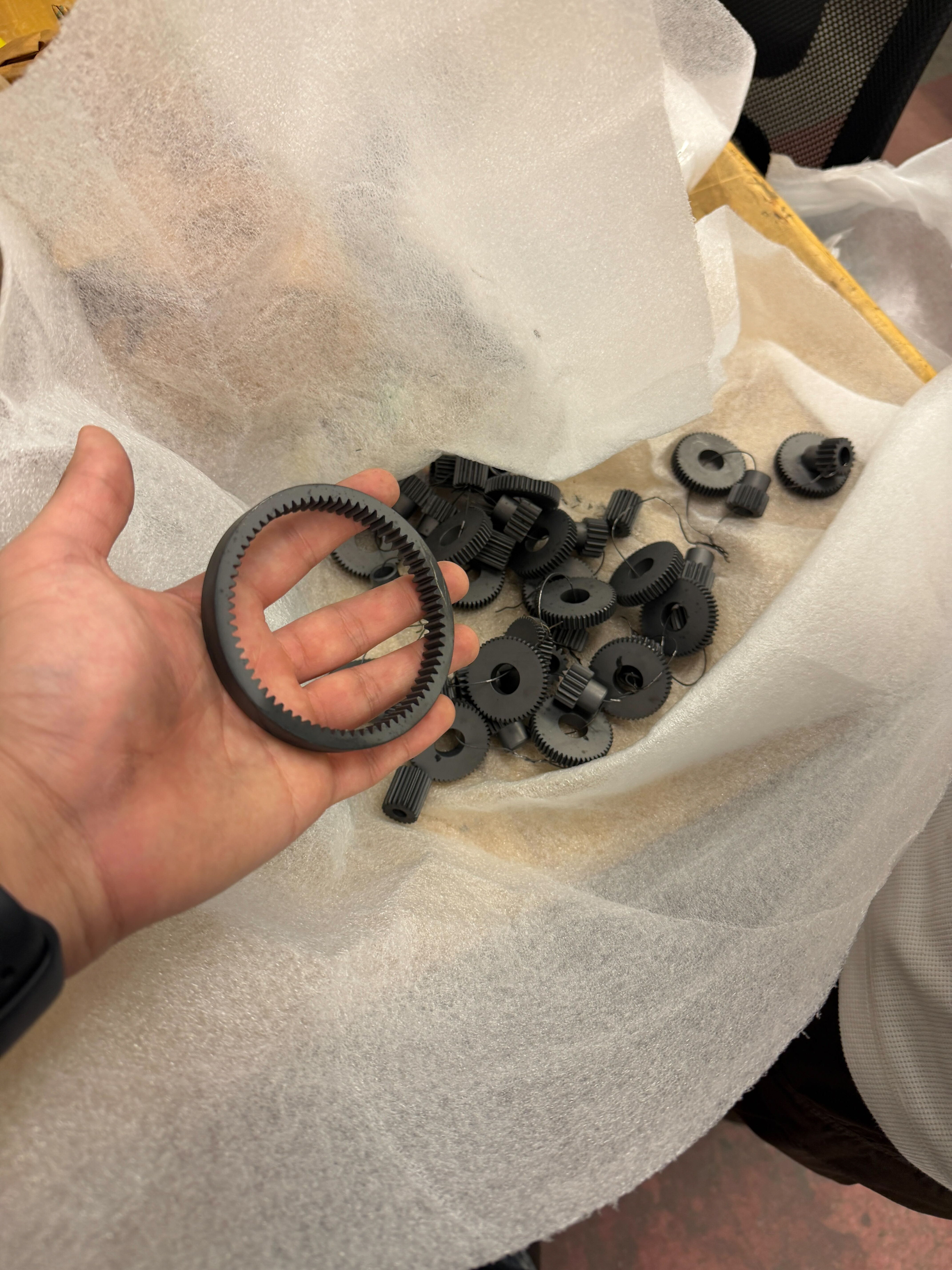
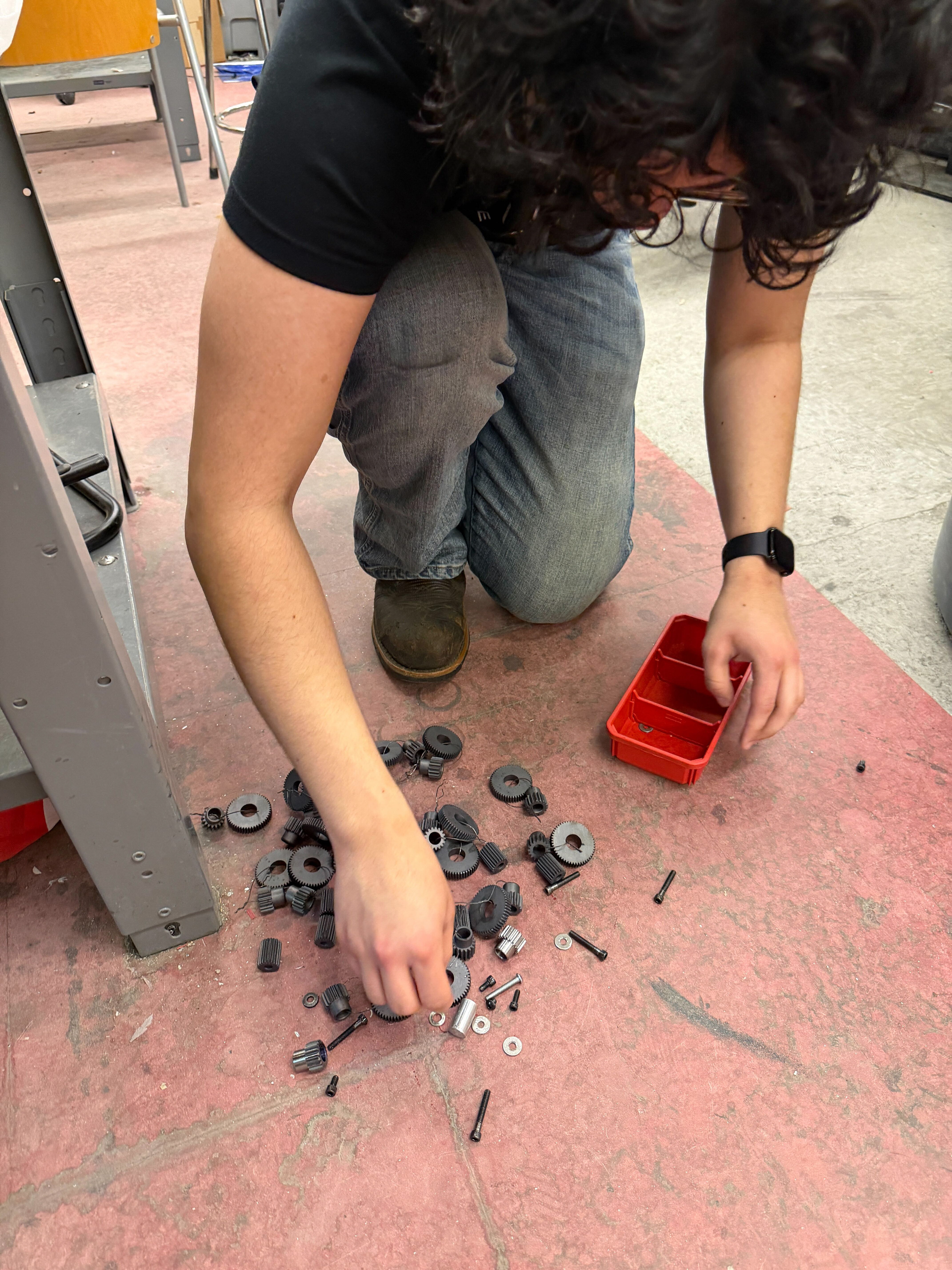
We then sent out the gears for Nitriding, which I then proceeded to drop.
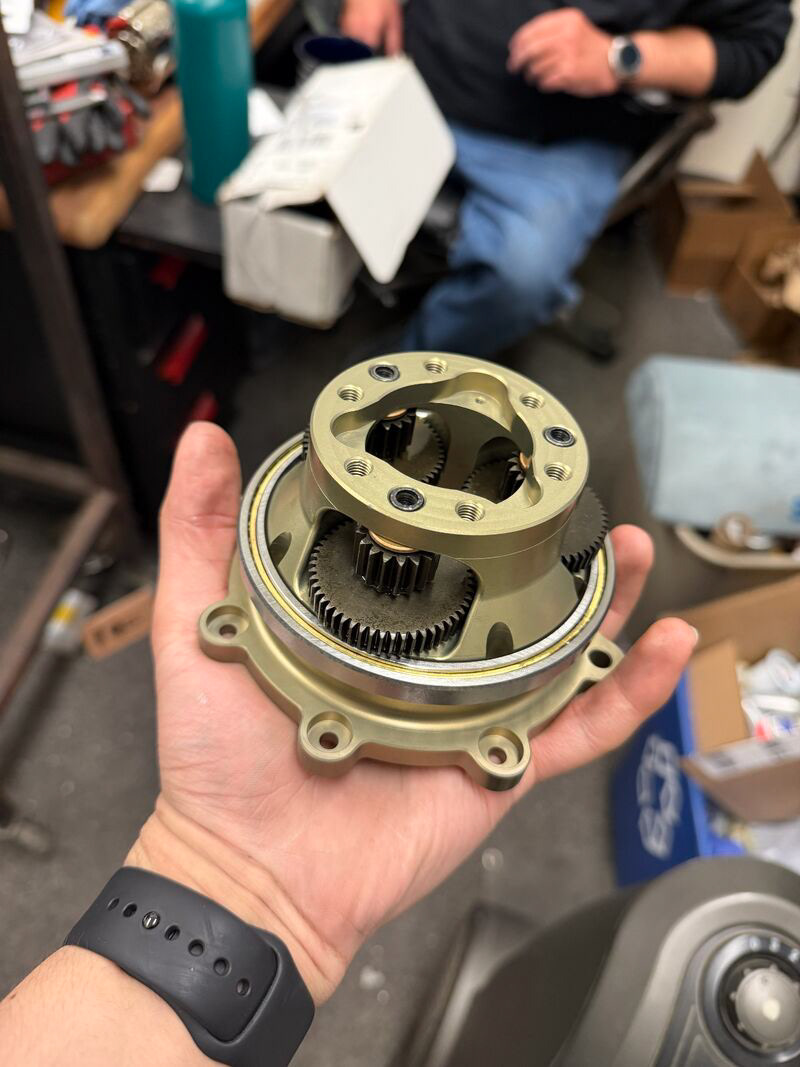
The gears fit perfectly in Rafael Tejeda's ('28) Carrier.